
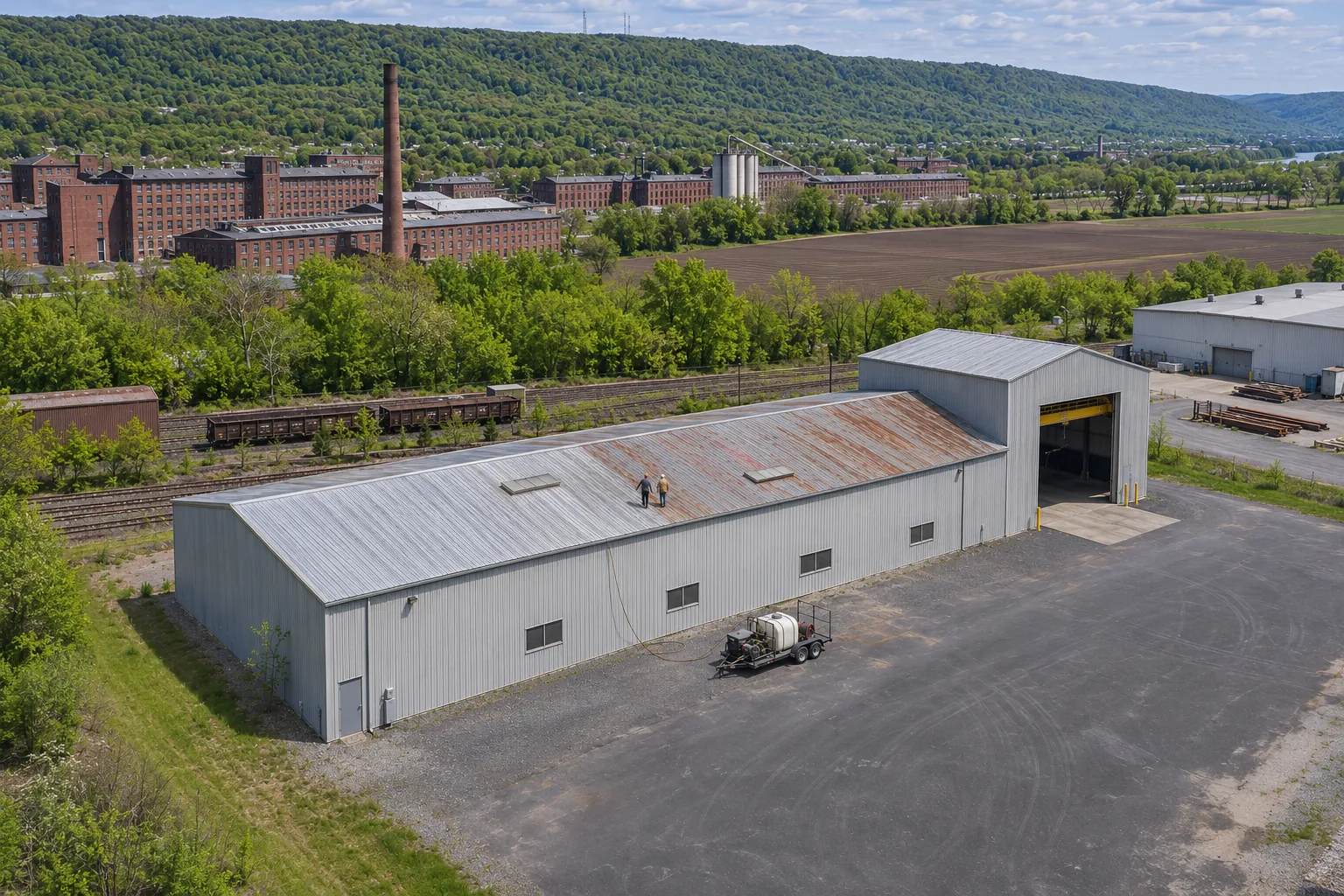
Wide drone view of a commercial building and its metal roof with the owner and roofers small in frame

Metal Roof Coating Questions in Reading

Straight Answers On Rust, Systems, Weather, And Cost

These are the metal roof coating questions in Reading we hear most from building owners and facility managers, grouped by topic.

Metal Roof Coating Questions in Reading by Topic

Answers to metal roof coating questions in Reading are grouped into eight topics below.

Keeping metal roofs in service

Is coating practical for a warehouse with several old roof repairs?

Warehouse coating can be practical when earlier repairs and the surrounding metal provide a sound base. We identify loose patches, incompatible sealants and moisture beneath the panels before recommending preparation.

On a Reading, PA building, the repair history helps explain which areas need opening rather than simply receiving another finish.

Can rust around a fabrication shop’s roof screws be treated?

Rust around roof screws may be treatable if the panel and fixing point remain sound. We examine corrosion beneath washers and check whether each screw still grips suitable support.

Cleaning the visible ring of rust is insufficient where metal loss or an enlarged hole has already weakened the connection.

How long can a well-maintained metal roof coating remain useful?

A coating’s useful life depends on its bond, thickness and exposure, so maintenance cannot establish a fixed service term. We inspect laps, fasteners and areas crossed by technicians to identify developing wear.

Keeping drains open and correcting damage helps preserve the assembly, but deteriorated panels still require their own repairs.

When does replacing metal roofing make more sense than coating it?

Replacement deserves consideration when widespread corrosion, unreliable attachment or wet underlying materials make coating unsuitable. We compare the work needed to restore a sound roof with the extent of components already failing.

A surface application should not be selected merely because it conceals deterioration that remains active below the finish.

Is coating worthwhile when the metal roof still needs repairs?

Coating may be worthwhile after repairs if the completed preparation leaves a serviceable roof for the specified system. We compare panel condition, leak history and future upkeep before recommending that approach.

The decision should rest on the roof’s remaining usefulness and repair scope, without assuming a particular financial return from the coating.

Metal preparation and restoration

What happens to rusty fasteners before an exposed-screw roof is coated?

Rusty fasteners need their attachment and surrounding metal assessed before coating preparation continues. We replace or repair unsuitable connections as the roof detail requires, remove loose corrosion and use compatible sealing materials.

The final coating relies on that preparation; a thick covering over a defective screw does not restore its grip.

Does restoring a Reading mill roof mean keeping every panel?

Restoration does not require keeping every existing panel on a Reading, PA mill roof. We separate serviceable metal from sections needing replacement and inspect the junction with brick walls.

A useful scope explains panel repairs, seam detailing and surface preparation together, so retained roofing can support the proposed coating system.

Which conditions should decide the coating used on a fabrication shop?

Drainage, existing finishes and rooftop use should guide coating selection for a fabrication shop. We examine adhesion after preparation and note contamination or traffic around equipment.

Silicone and acrylic have different application and maintenance considerations, so the choice should follow the roof findings rather than a claim that one product suits every building.

Silicone systems

Are slippery access areas a concern with silicone roof coating?

Wet silicone surfaces can complicate rooftop access, especially where equipment requires regular servicing. We discuss service routes and compatible protection before specifying the system.

Dirt pickup and future repair compatibility also deserve attention; those maintenance considerations remain relevant even when the coating itself is suitable for the prepared metal.

Does silicone coat count determine how long the finish lasts?

Silicone coat count alone does not establish durability; the specified finished thickness and quality of the prepared roof matter more. We follow the selected product’s application requirements and check coverage at ribs and details.

Adhesion, movement and later damage also affect serviceability, so additional passes are not a lifespan promise.

Should we choose silicone or acrylic for a roof that drains slowly?

Slow drainage needs investigation before choosing between silicone and acrylic. We identify low areas and blocked outlets, then compare the actual products’ limitations and application conditions.

Some silicone systems tolerate standing water, but that does not remove the need to correct drainage faults or deal with wet material below the metal.

Acrylic systems

Why can damp weather complicate acrylic coating on commercial roofs?

Damp weather can interfere with an acrylic coating’s drying window. We consider surface moisture, humidity, shade and overnight dew rather than relying only on the afternoon air temperature.

A roof must also meet the product’s preparation requirements; applying material ahead of unsuitable conditions can compromise the intended film.

What shortens acrylic coating life around metal roof laps?

Movement, poor adhesion and thin coverage can shorten acrylic coating life at panel laps. We check whether cracking follows an unresolved joint defect or wear in the surface itself.

A seam that keeps opening needs an appropriate repair detail before recoating, rather than repeated layers over the same movement problem.

How many acrylic coats does a prepared metal roof need?

The acrylic product specification and required dry film thickness determine the application passes. We assess the metal profile, repaired areas and coverage at raised ribs, then allow suitable drying between coats.

Counting passes without measuring the intended film build does not establish that the roof has received the specified protection.

Spray foam options

Will foam cure leakage from a poorly attached metal roof?

Foam should not be expected to correct poor metal roof attachment. We establish whether panels and supports are serviceable, trace the leakage and address wet materials before evaluating an overlay.

The foam assembly also needs suitable flashing and protective coating, with application conditions that allow the materials to perform as specified.

When should a spray foam roof be repaired before recoating?

A foam roof needs repairs before recoating where punctures, exposed foam or moisture have compromised the assembly. We distinguish sound material from sections requiring removal and verify compatibility with the existing finish.

Keeping that protective surface intact affects the roof’s continued use, but no recoating schedule can promise a particular lifespan.

What tradeoffs should a bakery consider before choosing spray foam roofing?

A bakery should weigh foam’s insulation and continuous surface against application controls and future protective maintenance. We review air intakes, nearby vehicles and access around equipment before planning the work.

Overspray exposure and conditions beneath the roof matter alongside substrate dryness, particularly where the building will remain in operation.

Shingles on commercial buildings

Can coating give aging commercial shingles a predictable remaining life?

Coating cannot provide a predictable remaining life for aging commercial shingles. We inspect brittleness, lost granules and flashing defects, then check whether the proposed products support the application at all.

Shingles or decking that have already deteriorated may need replacement even if some sections still accept a surface treatment.

What price information applies to coating a commercial shingle roof?

Shingle coating needs confirmed compatibility before the planning figures can be applied. Coating is about $2.50 to $4.00 per square foot of roof, compared with about $5 to $8 per square foot for replacement.

We evaluate roof size, access, coating type, thickness, coats, penetrations and flashing, plus fastener sealing and rust or seam preparation where relevant. The price comparison does not make an unsupported shingle treatment suitable.

Should a church replace curling shingles instead of coating them?

Curling shingles on a church need a replacement assessment rather than an assumption that coating will flatten or renew them. We examine the extent of damage, ventilation and underlying moisture.

Any proposed coating also needs explicit compatibility guidance; the building’s commercial use does not change the limitations of a deteriorated shingle covering.

Planning around conditions

Could ice at gutters explain leaks after a winter thaw?

Ice at gutters or drains can obstruct runoff and hold snowmelt against vulnerable roofing details. We inspect meltwater routes once access is safe, including laps affected by freeze-thaw movement.

Heavy wet snow also warrants attention to loading concerns, which should be assessed by a qualified professional rather than estimated from appearances.

Should coating wait until summer storm damage has been assessed?

Coating should follow assessment of summer storm damage so punctures, displaced flashing and opened seams are repaired first. We look beyond visible hail dents to the condition of panel connections and drainage.

Applying a finish over an unidentified defect can make later investigation harder without resolving the cause of water entry.

Can condensation beneath a brick mill roof be solved with coating?

Exterior coating does not solve condensation caused by indoor humidity or air leakage beneath a brick mill roof. We compare damp areas with ventilation, operating conditions and possible rain entry at walls or flashings.

Identifying the moisture source matters before any surface treatment traps attention on the wrong part of the building.

How can roof coating work fit around a snack food bakery’s shifts?

Coating work may fit around bakery shifts when access, cleaning and application can be coordinated with production. We review intake locations, deliveries and areas requiring protection below the roof.

Some tasks may need isolation or a different sequence, so the work plan should reflect the operation rather than presume every activity can continue.

Where does code review begin for a Reading roof restoration?

Code review begins with the reviewing authority and a description of the actual Reading, PA restoration work. Pennsylvania’s statewide building code framework is called the Uniform Construction Code.

We explain which metal components will remain and which need replacement, allowing the discussion to address concealed concerns and construction changes before the coating application is scheduled.

Nearby building questions

Can a Wyomissing commercial roof be recoated over old sealant?

Old sealant on a Wyomissing roof needs compatibility and adhesion checks before recoating. We inspect whether patches are still bonded and whether rust or moisture lies beneath them.

Loose or unsuitable material may need removal so the next application connects to a reliable surface rather than inheriting an earlier repair’s weakness.

Why inspect a Collingdale metal roof’s underside before coating?

An underside inspection can reveal moisture or corrosion not apparent from the exposed surface of a Collingdale metal roof. Where access allows, we compare those findings with exterior leaks and old repairs.

The information helps distinguish a coating candidate from an assembly that needs concealed damage addressed before surface preparation.

Do Downingtown equipment buildings need fastener repairs before restoration?

Fastener repairs are needed before restoration where screws or washers no longer perform properly on a Downingtown equipment building. We check holding strength, hole condition and adjoining metal instead of covering every fixing indiscriminately.

The selected repair should leave a connection suitable for the later seam and coating details.

How should a Brookhaven roof’s low spots affect coating selection?

Low spots on a Brookhaven roof need drainage assessment before coating selection. We check whether debris, panel deflection or roof details obstruct runoff and examine surrounding materials for moisture damage.

The proposed product must suit the resulting conditions, while drainage defects remain separate work that a surface film cannot correct.

What should be repaired around vents on a Ridley Park commercial roof?

Vent curbs and flashing on a Ridley Park roof need sound connections before nearby coating work begins. We inspect loose seals, damaged metal and deposits from exhaust, then coordinate any equipment servicing that affects the detail.

Preparation should leave both a compatible surface and a practical route for later inspection.

Still Have A Question About Your Roof?

Every roof is a little different. Tell us what you are seeing, and we will answer it for your building.

Get A Free Estimate
What To Have Ready
  • The question you have about your roof
  • Building type and roof size
  • Where the leaks or rust are

Sources

Code references in these answers come from this source.

More Metal Roof Coating Questions in Reading?

Call and ask, or get a ballpark range for your roof size and we will follow up.

Call Us(835) 214-7327